Tuesday, March 29, 2011

Assignment 5 Virtual essay

Option 2


There are so many famous photographers in the world, I have chosen one of them for me to work on this assignment. His name is Andrew Prokos. Andrew Prokos is a New York City photographer, and owns a company named Andrew Prokos Photography. Most of his photos were based on New York City, and he is specialize in architectural, location, and fine art photography. Andrew is such a success photographer who have been widely published his works in magazines and corporate annuals. In this report, I am going to find some similarities photos on internet, and then compare them with Andrew's work.


The first photo I chose from Andrew Prokos is the landscape photo below - a view of the Lake in Central Park in Autumn, New York City. In andrew's photo, he just captured some simple things, a lake, stone, tree, and some buidlings. However, the sense of his work is not that simple at all. When you looking at this beatiful landscape, you could totally feel, touch, and taste the beautiful autumn. Through this photo, I guess the sense of this photo is in order to bring people on the spot to the lake in Central Park, New York City.

A view of the Lake in Central Park in Autumn, New York City
By Andrew Prokos


The photo below was taken by Greg Maklae, it is a winter landscape photo with the view of Oak Mountain in NY. Comparing to Andrew Prokos's autumn landscape photo. Maklae's work has the similarity as capture the landscape in a season, but this one is winter. I think this photo have the same sense for everybody that to bring out the season winter when you looking at the photo. Seriously, if you try to feel the landscape in this photo, don't you feel cold?

Looking across to Oak Mountain, Speculator, NY
By Greg Maklae


 The second photo I chose from Andrew Prokos is the one below - a view of the Empire Sate Building and Midtown Manhattan at Dusk. From the photo, you could see that the Empire State Building's crown andspire are lighted in blue and white for Hanukkah.


view of the Empire Sate Building and Midtown Manhattan at Dusk
By Andrew Prokos


The photo below was a panoramic night view of downtown Toronto which taken by Oleksiy Maksymenko. The photo was taken at Harbourfront. Comparing to Andrew Prokos's work, this one gives me the same inspire as the panoramic night view of a city.


Panoramic View Of Toronto Downtown Harbourfront Skyline Nighttime Scenery. Ontario Canada
By Oleksiy Maksymenko


The Third photo I chose from Andrew Prokos is the one below - A view of Times Square at night, New York City. The photo was taken at Time Square, New York. From the photo, Andrew Prokos had captured a beautiful night view of New York City.

View of Time Square at night
By Andrew Prokos


The photo below was taken by Geoff Daivs. It was a view of the panoramic night view of Yonge street, downtown Toronto. Comparing to Andrew Prokos's work. This one gives me the same view of a city's street night, and the same sense that when night falls the city is still live with people.


view of Yonge Street, Downtown, Toronto
By Geoff Davis


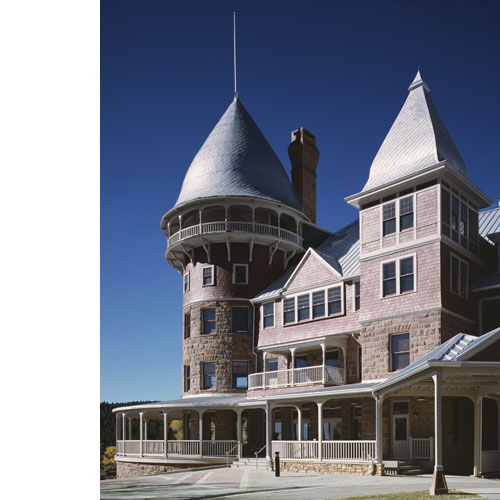
The Forth photo I chose from Andrew Prokos is the one below - The crown of 750 Lexington Avenue in Midtown Manhattan, New York City.

750 Lexington Avenue Crown
By Andrew Prokos


The photo below was a view of the Montezuma Castle which taken by Chun Y Lai. Comparing to Andrew Prokos's work. This one could show me the same meaning of what is the Architectural Photographs.

Montezuma Castle NM
By Chun Y Lai


The last photo I chose from  Andrew Prokos is the one below - A painter with his model in Central Park, New York City. It is a lifestyle photograph.
The Painter, Central Park
By Andrew Prokos


The photo below is another lifestyle photo by Simon Powell. In the photo, He have captured a very simple lifestyle, two man are running on the road. Comparing to Andrew Prokos's work, this one is similarities  as that one, because both of them are capturing the simple life style. It brings us a comfort feeling when we looking at the photo.


Lifestyle,  By Simon Powell


References:
Images Resources:

http://api.ning.com/files/ZGEBnOZbkUZ9VPkva4CmDhX**I487af-SLLbygt8GxlmnjSCwCpB*dJPdmguK5JnoRNwfCjKhaYU98FRgMe3KJoYRCvDQCMK/OakMt0043.jpg

http://andrewprokos.com/d/empire-state-view-dusk?g2_itemId=6143&g2_serialNumber=9

http://www.worldofstock.com/slides/TAE2853.jpg

http://andrewprokos.com/d/night-photo?g2_itemId=1197&g2_serialNumber=7

http://www.flickr.com/photos/timberwolf1212/2702967198/

http://andrewprokos.com/d/750-lexington-ave-crown?g2_itemId=5831&g2_serialNumber=7

http://www.chunlaiphotography.com/images/architecture/7-X123.K.jpg

http://andrewprokos.com/d/central-park-painter?g2_itemId=5861&g2_serialNumber=5

http://www.simonpowell.net/master.html


Monday, March 21, 2011

DB 11 - Week 11: Kertesz and Cartier-Bresson versus Smith and Salgado

Compare the work of Andre Kertesz and Henri Cartier-Bresson versus the work of Eugene Smith and Sebastio Salgado. They are photojournalist with different approaches.


1. Andre Kertesz

André Kertész, Broken Plate, 1929


2. Henri Cartier-Bresson

Henri Cartier-Bresson, Tretyakovsky Art Gallery, Moscow, USSR, 1954

3. Eugene Smith

W. Eugene Smith/Time & Life Pictures/Getty Images
Jun 01, 1944
http://www.life.com/gallery/23016/image/51511847#index/0


4. Sebastio Salgado

Sebastião Salgado
Firefighters at Work
Sabotaged Oil Wells in Kuwait,
1991


What are the main differences and similarities?


Through some of their photographs, I have figured out that the main differences between the work of Andre Kertesz and Henri Cartier-Bresson versus the work of Eugene Smith and Sebastio Salgado are the visibility of the photographer. Andre Kertesz and Henri Cartier-Bresson believed that photographers should be invisible and only be seen as doing their jobs, and not to make emotional connections to their subjects. The approach they use is take photo without any edited on it, but just leave them as they are. In comparison, Eugene Smith and Sebastio Salgado believed that photographers should be visible, and the best photos are created by interacting with your subjects. The approach they use is the complete opposite. These pionts are the main differences between them. However, they also have few similarities points. Firstly, there is no limitaion on both of their photographs, the objects could be anything. Agian, it is that they both wanted to depend on the photographs to spread their senses to the public. 


What’s the better journalistic approach?

If I never took this photography course, I would consider that one of the approach is better. However, after I studied this course, I think I cannot give a answer of this question. In my opinion, there is not better approach on the jouralistic photography. Since each approach has its advantage. Such as Andre Kertesz and Henri Cartier-Bresson’s approach are good at leavin gthe photos unedited, and staying true to the term reality. On the other hand, Eugene Smith and Sebastio Salgado's approach are good at adding more depth and sense to photos by photo enhancement.


Image Sources:
http://www.threepennyreview.com/images/-gallery/104cover.jpg
http://i.pbase.com/o3/98/316398/1/88558913.qnFIdOq7.bresson_moscow54_tretyakovka_a.jpg
http://www.life.com/gallery/23016/image/51511847#index/0
http://pdngallery.com/20years/photojournalism/images/18_sebastiao_salgado.jpg


Tuesday, March 15, 2011

Assignment 1 PART 2 - Web 2.0 Photo Journal Blog

Part 2: Press photography versus art photography

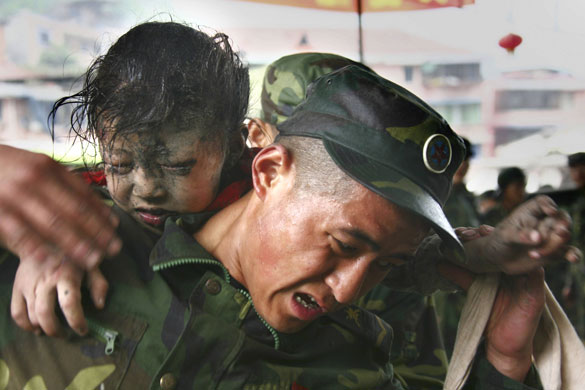
                                                                Press Photo 1
 Photographer: Bo Bor

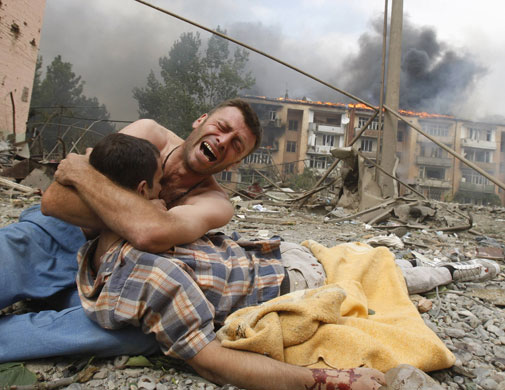
Press Photo 2

  Photographer: Gleb Garanich


Art Photo 1

Dark City
By Seb Janiak

Art Photo 2

Breaunna in Cat Mask
By Albert Watson


In my opinion, the main differences between art and press photography is significance. Press photography can be defined as press photographers capture images to record news and lifestyle stories for publication. Those two press photos I posted upon could give you good examples. The first press photo was taken by Bo Bor, a Reuters photographer based in China, the photo was recorded the event of earthquake survivors rescue works in Sichuan Province. And the second press photo was taken by Gleb Garanich, a Reuters photographer based in Ukraine, in the photo, you could see a Georgian man mourning his brother after a bombardment in Gori. Through the press photos, the readers could totally feel what was it like to be in the news, events, and stories. In contrast to the press photography, art photography is defined as the photos are created in accordance with the creative vision of the photographer as artist, so it is a thing that could influence photographers to create their own vision during the photo-taking process, but could not use to capture the news, events and life stories. If you compare the press photos and art photos I posted upon, you will clearly understand what is the main differences between them. Although press and art photographs have so much differences, they have a little similarities. It is there is no limitation on the images capturing. The images can be people, nature, landscape, buildings, fashion......and so on. Both of the photographs are created by photographers who have artistic knowledge and highly response.


 Is it ethical and acceptable to alter art photographs? I believe that it is ethical and acceptable to do that.  Photo enhancement is a good example,  base on the photoshop functions, artist could edit the art photographs whatever they like in order to get different outcomes. For example, a portrait, through the photo enhancement, you can make the portrait's expression to be happy, sad, mad.....etc. Therefore, altering the photo not only will not change the sense of the photo, but also will make the photo looks more perfect. On the other hand, is it ethical and acceptable to alter press photographs? In this point, I think it is not ethical and acceptable to do that. Since the definition of press photographs is image to record news, events and lifestyle stories for publication. Therefore, if one alter the press photographs that will directly change the signification of the original photograph.

Reference List:
Images sources


Wednesday, March 9, 2011

D9 Week 9 - Shooting the truth: Photojournalism

What's the role of photo journalism?


The role of photojournalism is a branch of journalism to record down events that occur in our world. Journalist generally take some truth photos that occur in the events, and they would write a specific story base on the photos. Through the photos, the readers could totally understand the background of events. Again, the photos could gain the authenticity of the story. In my opinion, the story from the photos Journalist offer are news related, and the context of photos are directly connected to the story.

Image source from Google Images


Are there rules that photojournalists should follow? Why? Why not?

"NPPA Code of ethics" states that visual journalists and those who manage visual news productions are accountable for upholding the following standards in their daily work:
  1. Be accurate and comprehensive in the representation of subjects.
  2. Resist being manipulated by staged photo opportunities.
  3. Be complete and provide context when photographing or recording subjects. Avoid stereotyping individuals and groups. Recognize and work to avoid presenting one's own biases in the work.
  4. Treat all subjects with respect and dignity. Give special consideration to vulnerable subjects and compassion to victims of crime or tragedy. Intrude on private moments of grief only when the public has an overriding and justifiable need to see.
  5. While photographing subjects do not intentionally contribute to, alter, or seek to alter or influence events.
  6. Editing should maintain the integrity of the photographic images' content and context. Do not manipulate images or add or alter sound in any way that can mislead viewers or misrepresent subjects.
  7. Do not pay sources or subjects or reward them materially for information or participation.
  8. Do not accept gifts, favors, or compensation from those who might seek to influence coverage.
  9. Do not intentionally sabotage the efforts of other journalists.
(https://gbc.blackboard.com/webct/urw/lc5122011.tp0/cobaltMainFrame.dowebct)


Is the ethics of taking journalistic photos different than the ethics of writing a news story?

Journalistic photos and news story writing should have the same ethics rule. Although both jobs are performancing the different works(one is recording the events of the world,  and the other one is presenting to the public), both jobs should follow a common rule is bringing out the truth. In general, Journalistic photos is give readers the truth photos from the event; on the other hand,  news written is base on the photos to write specific story from the event, so they should have the same ethics rule. 

What's the impact of altering press photographs? Should they be edited (at all) in postproduction?

The impact of altering press photographs could be positive or negative depending what intention of the alter.  If people altering press photographs only for enhancing the photos, this would not give too much impact for the photo, but a lilttle positive impact too, because it makes the photo look better. However, if people altering the photographys for changing the truth, then the impact of that could be very large. Since Photographs were the evidence of truth, it were used to record the important events in the old days, so if people altering press photographys in the wrong way so that would distort the truth

Work Cited:

https://gbc.blackboard.com/webct/urw/lc5122011.tp0/cobaltMainFrame.dowebct

Image sources:
http://www.canberra.edu.au/communication/assets/journalism.jpg


Tuesday, February 15, 2011

DB 6 - Documenting the great depression

Why the project has significant impact on the society?

The Great Depression was a terrible economic depression, and it was a really hard time for everybody. During the period, those wealthy people became penniless; those poor people could not afford the basic needs to support their families. The main problem of the great depression was the unemployment problem. There were a lot of people lost their jobs or could not get a job during the time. Many families were force to move from their home to search for work.  All of these caused a lot of people get the key of the street.

On the website - "FSA/OWI B&W PHOTOGRAPHS", it states that " Farm Security Administration(FSA) is a landmark in the history of documentary photography. The images show Americans at home, at work, and at play, with an emphasis on rural and small-town life and the adverse effects of the Great Depression, the Dust Bowl, and increasing farm mechanization. Some of the most famous images portray people who were displaced from farms and migrated West or to industrial cities in search of work. " (http://memory.loc.gov/ammem/fsahtml/fahome.html)

In my opinion, the FSA collection had a significant impact on the society, because when the photographs were published, they would be disseminated all over the world. Everybody could understand how hard are Americans lives. Again, those photographs from FSA are historical proof from the great depression. Today, if you look at those photographs, and you could totally feel that the huge stress of the life from the great depression period.

Bud Fields and his family. Alabama. 1935 or 1936. Photographer: Walker Evans.
Squatter's Camp, Route 70, Arkansas, October, 1935.
Photographer: Ben Shahn


What was the role of Migrant Mother photograph in the period or great depression and what is it nowadays?


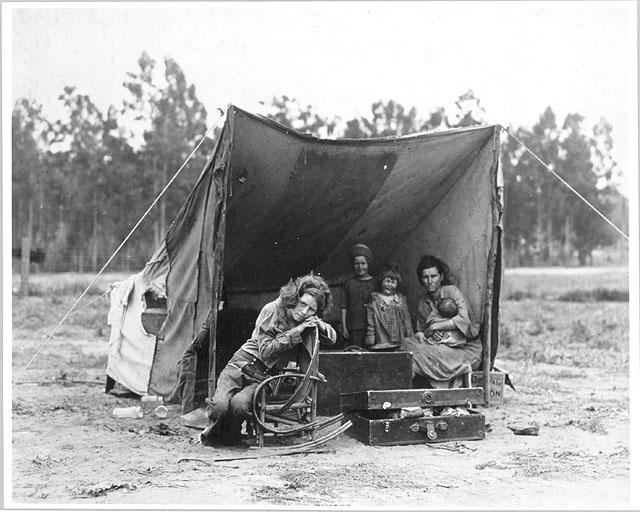
Dorothea Lange was a famous American documentary photographer who worked for the Farm Security Administration (FSA) during the great depression. Migrant Mother is her famous photograph collection. In these photographs, you could see a upset and desperate mother, and her children are leaning around her with the hungry face. Although that mother’s age was thirty-two, she looked much older than her age in the photographs. The role of the Migrant Mothers” provided society with strong proof of the effects of the Great Depression. From the background of the photograph, you could see how severe are their life; from the mother’s eye, you could see that she is in deeply helpless with her family. So nowaday, I believe that “Migrant Mother” photographs are good lesson for us to understand that what they got during the Great Depression and World War II, and the evidence encourage us to join hands and offer a helping hand.

Migrant Mother. Photographer: Dorothea Lange
.
The photograph that has become known as "Migrant Mother" is one of a series of photographs that Dorothea Lange made in February or March of 1936 in Nipomo, California. Lange was concluding a month's trip photographing migratory farm labor around the state for what was then the Resettlement Administration. Photographer: Dorothea Lange


Reference List:

"America from the Great Depression to WWII", Dec 15 1998. American Memory. Feb 15 2011 http://memory.loc.gov/ammem/fsahtml/fahome.html.

Photographs:
1. http://lcweb2.loc.gov/pnp/ppmsc/00200/00234r.jpg
2. http://lcweb2.loc.gov/pnp/ppmsc/00200/0041r.jpg
3. http://lcweb2.loc.gov/pnp/cph/3b40000/3b41000/3b41800/3b41800r.jpg
4. http://lcweb2.loc.gov/pnp/ppmsc/00200/00230r.jpg


Tuesday, February 8, 2011

Assignment 2 Photo Manipulation Assignment

Photography and ethic: You as a photographer who edited/altered images


As we discussed the past week, there are so much different between the modern photography skill and the early days skill, and photo enhancement is a strong example to prove this point, so in thisa week, I am gonna try to be a photography to edit a photo in order to show you how people ususally edit their photo.

For photo enhancement, you do not really need a lot of professional softwares to perform it, but just a simple tool - Adobe Photoshop. Now, I am going to use photoshop to show you how to edit a photo. I believe that there are so many people got upset about their pimples, and run away from the camera when peolple are taking picture. However, if you  use the skill I recommending below, then you will not get upset about the pimples anymore. The first original photo below is just random searched by me from google image, you could see the girl's face is full of pimples, I believe that it will not be hided even if put on make up, but photoshop could solve the probelm. First step, zoom into the area needing to be edited. Second step, click on the healing brush tool, and resize the tool to a size large enough to cover the largest range. Third step, find an area that is clear with a similar color as the area you are trying yo edit, press the "ALT" button(on the keyboard) and click on that clear area to pick up the color range. Fourth step, randomly click on each pimple to cover it with a similar color and texture of the clear area. Finally, do the same steps agian to different area of the pimples. Now you could see the pimples on the face are all gone, and I suggest you to change the lightness higher in order to make the skin looks more white. Then you could see a totally different face with perfect skin just like the second photo below.
                                                             Before
Photo resource from Google Image


After


Again, I am going to show you another magic of photoshop. The first original photo below is randomly searched from google image. In the image, you could see a lady is really fat. Now if you follow my steps to edit the photo, then you could use your magic to make her become a skinny lady. First step, click on Filter menu and select Liquify. Second step, in the liquify effect window, click on the freeze tool to apply the freezing function. The freezing function is used for freezing the area in the photo that you do not want to edit. Third step, you start to highlight the parts of the body which u need to make thin. Fourth step, go to the tool bar again, to seclect the wrap tool, and change it to the ideal size you want. Finally, you could use the wrapping brush to touch the edges of the body area with to make them look thin. For this skinny skill, you need to touch the edges of the body carefully, or you would make the body looks abnormal. And the second photo below is the one after I edit, you could see how is the photoshop magic!

                                                                        Before

Photo resource from Google Image

After


For all of you, if you try more, then you will discover more photo skills for photo editing. In conclusion, photo enhancement is a magic!


Reference List:

Google Images


Sunday, January 30, 2011

Part 1: The role of portraits in the early days of photography and portraits today - 15%

What are the main differences and similarities between portraits in the early days of photography and portraits today?

Comparing to the earlys day, the role of portraits in modern days is unfathomable. Due to the technical and society problem. Photography in two different ages has so much differences. Firstly, early in the days photograph was luxury, because it was a new development of such technology. However, as time and technical progressed more photographers appeared, and the price was avaliable to the middle class. Secondly, the photograph and portraits in the early days were mainly done in a studio but in this present time with the technology advancement we have, photograph can be taken anywhere and any time. Lastly, it might be take a long time to take a photograph of a self portrait in the early days but now it'll only take a second or two. Although there are so many differences, they still have some similarities.  The mainly similaritie is photography is art, no matter in the early day or modern day, no matter how much differences between their price, technical, time...... They are still considered art. Photography still define as artist creates art of deliberately arranging items in a way that influences and affects human of the senses. They are still used by catching the beautiful things or moments in order to people could have a good memory.


Who was the photographer and who was the subject of photographs in the past and today?


In the past days, it is so difficult to be a photography, because the cost to be a photography was so expensive. Plus this job was not that popular in the past days, so photographers were so limited. Now, anyone got interest in photography, they can just spend few money to buy a digital camera, then they can become a  hobby photographer, of course the professional photography need to spend more oney on it, but the price range is still cheaper than the range in the past day. Photography is no longer an expensive hobby, as it is affordable for just about anyone. The subjects of photos in the past were usually focused more on people, instead of physical objects, landscapes or buildings. Photos were taken of people who were generally rich, famous, and memorable. Today, you can take high quality photos of any object or person whatever you want by a digital camera.


What was the impact of technology on the portraits in the past and today?


In the past day, the technology on the portraits was much worse than today, for example, in the past days, we needed to developed the photo in the black room, but now, we can use machines or computer to do all of those, so it is so much easier. Of course there is still some of those black rooms exist in the world now, but it was only used by those people prefer to use traditional developing method, instead of modern technology. Again, comparing to the camera in the past day and today, the modern camera is so much better than the traditional camera, since it has more functions than the traditional one. Lastly, the modern photography skills on the portraits is advanced. Photo Enhancement is a good example, now you can use Photoshop to change the orginal photo whatever you want, such as  the contrast, brightness, sharpness, and quality of a picture. Further more, if oyu own professional photoshop skills, you could renew a old photo, or make a old lady photo to become a teen girl......and so on. As technology changes everyday, new ideas and methods will be introduced and we will have to adapt to the changes.


Wednesday, January 26, 2011

can art be mechanically reproduced?

When something is reproduced for so many times is that art? What's the importance of the mechanical reproducibility of the art? What was the impact on mechanical reproducibility on the society?

In my opinion, Artist creates art of deliberately arranging items in a way that influences and affects human of the senses, that is the main purpose that why the art exists in the world, but if one artist spends a long time to create a product, and the other people just use the original product to make a alot of copies, is it still an art? I would tell you, yes, it is still an art, although it is reproduced for so many times, it would not be take away the sense of the art, on the contrary, it is a good way to propagandize the artist's art, because if there is only one original in the world, then how could it makes people get to know about its exist? On the other hand, if there are so many copies of it, then the artist's art could be spread all over the world in order to influence and affect human of the senses, so I strongly agree that art can be mechanically reproduced. Again, this point is the importance of the mechanical reproducibility of the art too. Mechanical reproducibility had a major impact on society, it is the copyright problem, such as film industry, some people use one original fim to make so many dvd copies so that they could obtain benefit but without pay out, so that is the negative impact on society.


Is photography art, or contribution to the art? Is it just a tool used by artists?

I believe that photography is art, and it is not just a tool used by artist. Normally Photography seems so easy to take any picutres by using a camara, however, getting catch a perfect image is not that easy like you think, and the final outcome of the photograph you take is solely based on the steps you take that lead you to that one photo. A photographer will use different positions, gestures, lighting and effects to capture certain motions in time. For example, if one uses a  luxury camara but without any photography skills, he/she could just random play with the camara for fun, so the most importance is photography art could appear photographies' senses through a success photo.


How and why Henry Pitch Robinson created Feading Away? What was the reason?

1858, Henry Pitch Robinson used his pioneering combination printing, joined multiple negatives to form a single image to create his success opus --- Fading away. It depicted the peaceful death of a young girl surrounded by her grieving family. Through this picture, you could see how are the true and the painful human experiences. At the same time,  it could tell you that how well is Henry Pitch Robinson's photography skills.


Photography has impacted the world of art and influenced some changes in the area of accessibility to art. If mechanical reproduction created revolution, what is happening now with the digitalization?


In the modern days, digitizing is becoming more common and everyone is depending on computers to edit images. Photo Enhancement is a good example, now you can use photoshop to change the orginal photo whatever you want, such as  the contrast, brightness, sharpness, and quality of a picture. Further more, if oyu own professional photoshop skills, you could renew a old photo, or make a old lady photo to become a teen girl...... and so on.